

Article summary
- There's no fixed price for Facebook ads: you set a daily or lifetime budget, and Meta's auction decides what each result costs.
- Published US benchmarks put the average cost per lead around $27, with home improvement higher and real estate lower.
- Meta adds GST/HST to ad charges in Canada unless you add your GST/HST registration number to the ad account.
- Work backward from your average job value and close rate to set a budget, then run it for at least a week before judging.
- Ad spend, management fees and creative are three separate costs. Compare quotes line by line.
How much do Facebook ads cost? There’s no fixed price: you choose a daily or lifetime budget, and Meta’s ad auction decides what each click or lead costs. For a local service business in BC, a useful test usually means a few hundred dollars a month in ad spend, plus GST/HST unless you’ve added your registration number to the ad account.
This guide is for owners in the Lower Mainland and Fraser Valley who have boosted a post or two and want to know what a real budget looks like. We’ll cover how pricing works, what published benchmarks say, the Canadian tax detail most guides skip, and a simple way to set your own number.

How Facebook ad pricing works
Facebook and Instagram ads are sold through an auction. Every time there’s a spot to show an ad, Meta compares the ads competing for that person and picks one based on bid, expected results and ad quality. You never pay a sticker price. You set how much you’re willing to spend, and the auction sets what each result costs.
According to Meta’s pricing overview, you control spending in two ways:
- Daily budget: the average you want to spend per day. Meta may spend up to 75% more than that on a given day, but it won’t spend more than seven times your daily budget in a week.
- Lifetime budget: a cap for the whole campaign. Daily spending can go up and down, but the total stays under the cap.
You can also set a campaign or account spending limit, and pause an ad at any time, as Meta’s help page on ad costs explains. So the honest answer to “how much does it cost to advertise on Facebook?” is: exactly as much as you decide, and no more.

What Facebook ads cost on average
Averages help you sanity-check a quote or a result. The most widely cited source is the yearly benchmark report from WordStream by LocaliQ, a US company. Its 2026 Facebook ads benchmarks don’t state a currency, so treat the numbers as US figures, not Canadian-dollar prices.
Cost per click
| Campaign type | Average cost per click | Average click-through rate |
|---|---|---|
| Traffic (visits to your site) | $0.60 | 1.93% |
| Leads (forms, calls, sign-ups) | $1.80 | 2.70% |
Clicks on lead campaigns cost more because Meta shows those ads to people more likely to fill in a form. A cheap click that never becomes an enquiry isn’t a bargain.
Cost per lead by industry
The same report puts the average cost per lead at $27.39, with wide gaps between industries:
| Industry | Average cost per lead |
|---|---|
| Real estate | $13.74 |
| Health and fitness | $27.11 |
| Physicians and surgeons | $32.14 |
| Home and home improvement | $42.95 |
| Dentists and dental services | $61.56 |
If you run a renovation, HVAC or roofing company, the home improvement figure is the closest guide. Remember that a lead is not a customer. What you pay per booked job depends on how many leads you reach, quote and close.
What drives your Facebook advertising cost up or down
Two businesses on the same street can pay very different prices. These are the main reasons.
- Your objective. Meta prices results differently depending on what you ask for. Optimizing for leads costs more per result than optimizing for clicks or views.
- Your audience. A tight radius around Port Coquitlam or Abbotsford is a smaller pool than all of Metro Vancouver. Meta’s pricing overview says broader audiences and more placements give its system more room to find cheaper results.
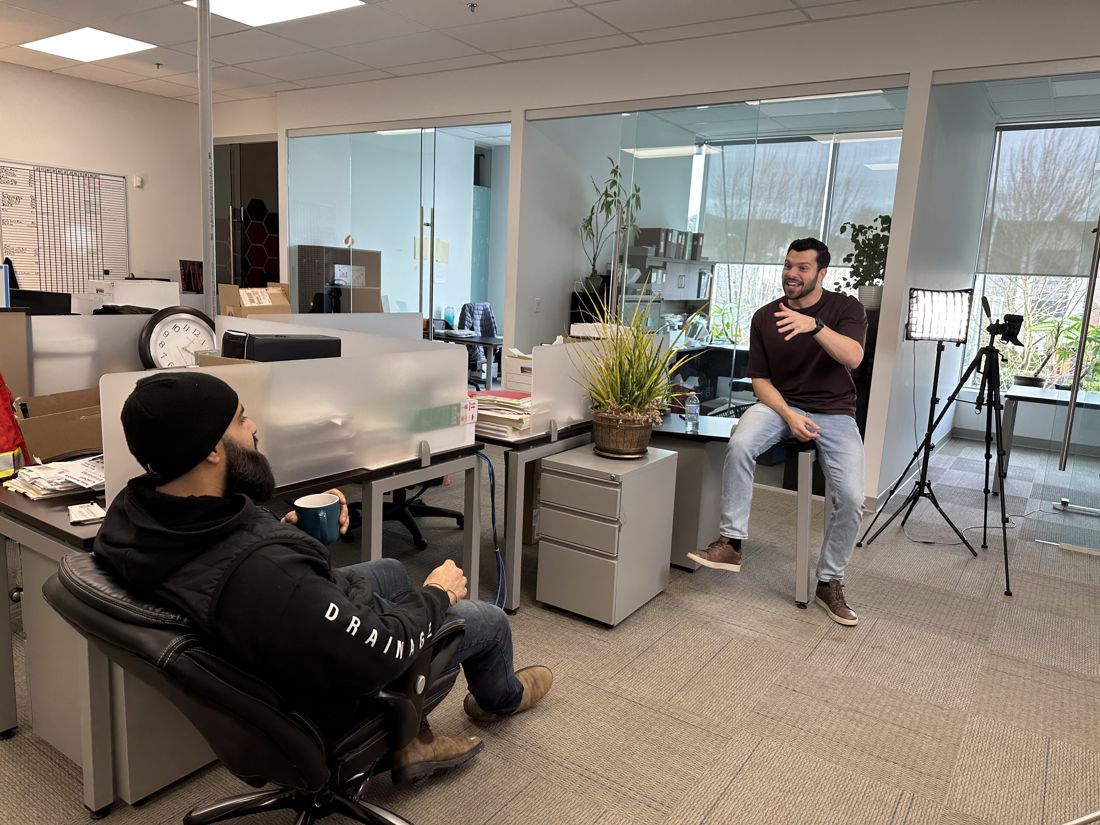
- Your ad. Ads people ignore cost more to deliver. Short, real footage of your crew and your work tends to hold attention better than stock photos. That’s why we film video ads at your business rather than using generic clips.
- Season and competition. Heating businesses tend to compete harder in the fall, and landscapers in spring. Prices rise when more advertisers chase the same people.
- Time to learn. Meta recommends planning for at least seven days of spending so the system can find the right people. Changing ads every two days resets that learning.

How much should a local business spend on Facebook ads per month?
Start from your business, not from Meta’s minimum. The Business Development Bank of Canada gives a rule of thumb of 5 to 10% of revenue on marketing for businesses that sell to consumers, and 2 to 5% for business-to-business. Facebook ads are one slice of that total, not all of it.
Then work backward from one job. Here’s an illustrative example (not a client result):
- Average job value: $2,000
- You close 1 in 4 quotes
- You want to pay no more than $200 in ads per booked job
- So you can afford about $50 per lead ($200 ÷ 4)
- Ten booked jobs a month would need about 40 leads, or roughly $2,000 a month in ad spend
Your numbers will differ. The point is to set a budget you can measure against booked jobs, not against likes. How fast you call leads back matters just as much as the ad itself. A simple follow-up system makes sure every new lead gets a fast reply.
Is $1 or $5 a day enough?
Meta suggests starting with at least $5 a day, and its minimum budget guide says minimums vary by country, objective and currency. Ads Manager will warn you if your budget is too low.
At $5 a day you’ll spend about $150 a month. That can test whether an ad gets attention, but at the benchmark cost per lead above it would bring in only a handful of leads. That’s too few to judge a service business fairly. If your budget is small, narrow the test: one service, one area, one offer.
GST/HST and billing: why Facebook charged you early
Two billing details surprise Canadian owners.
GST/HST. Since July 2021, Meta ads bought by advertisers in Canada are charged GST or HST at the local rate, according to Meta’s GST/HST help page. If you add your GST/HST registration number in Payment settings, Meta doesn’t add the tax. In Quebec, QST may also apply. Meta notes it can’t give tax advice, so ask your accountant how to handle it on your books.
Payment thresholds. With automatic payments, Meta charges your card when your spending reaches your payment threshold. Meta’s threshold page explains that the threshold rises over time as payments go through. That’s why new advertisers often see several small charges before the campaign ends. Because tax is added on top, a charge can be slightly higher than the threshold itself.
Ad spend vs management fees vs creative
When you compare quotes, split them into three costs:
| Cost | What it pays for | Who gets the money |
|---|---|---|
| Ad spend | The ads themselves, plus GST/HST | Meta |
| Management | Setup, targeting, testing, reporting | You or your agency |
| Creative | Photos, video, ad copy | You, a freelancer or your agency |
A low monthly price sometimes means a small ad budget with management bundled in, or no new creative at all. Ask what goes to Meta and what goes to the agency. If you’d like to see how we set up Facebook and Instagram ads for local businesses, the service page explains what’s included.
Is boosting a post cheaper?
Boosting a post from your Facebook Page or Instagram profile uses the same auction, so it isn’t cheaper per result. It’s simpler, with fewer options. Meta lists the Page and Instagram profile as the easiest places to buy ads, and Ads Manager as the place for full control over objectives, audiences and placements. For leads, Ads Manager is usually the better tool.
Conclusion: set a budget you can measure
Facebook ads cost what you decide to spend. The auction sets the price of each result, published US benchmarks put an average lead around $27, and Canadian advertisers pay GST/HST on top unless they add their registration number. The budget that makes sense for you comes from your job value and close rate, tested for at least a week and judged on booked jobs.
If you’d like help working out a realistic budget for your business, book a free strategy call. We’ll look at your numbers with you and tell you plainly whether Facebook ads are the right next step.
Frequently asked questions
Is $5 a day enough for Facebook ads?
Meta suggests starting with at least $5 and running for at least seven days. That's enough to test an ad, but for a local service business it rarely produces enough leads to judge the results. Most owners need a bigger budget, or a narrower test, to learn what works.
Does Facebook charge GST or HST on ads in Canada?
Yes. Since July 2021, Meta charges GST or HST at your local rate on ads bought by Canadian advertisers, unless you add your GST/HST registration number in Payment settings. In Quebec, QST may also apply. Ask your accountant about claiming the tax back.
Why did Facebook charge my card before my campaign ended?
With automatic payments, Meta charges you each time your spending reaches your payment threshold. The threshold starts low and rises over time as payments go through, so new advertisers often see several small charges early on.
How long should I run Facebook ads before judging results?
Meta recommends planning for at least seven days of spending so its system can learn who responds. For lead campaigns, judge results on booked jobs over a few weeks, not on clicks in the first few days.

Written by
Murilo T. Founder, Rank My Business Today
Murilo spent 20 years in the software industry supporting the marketing departments of other companies. In 2024 he founded Rank My Business Today to help local businesses across Greater Vancouver and the Fraser Valley become the name people find, trust and choose.
More about Murilo